How to rebook clients before they leave the chair
One question at checkout is worth ten follow-up emails. Here is how to make that question routine.

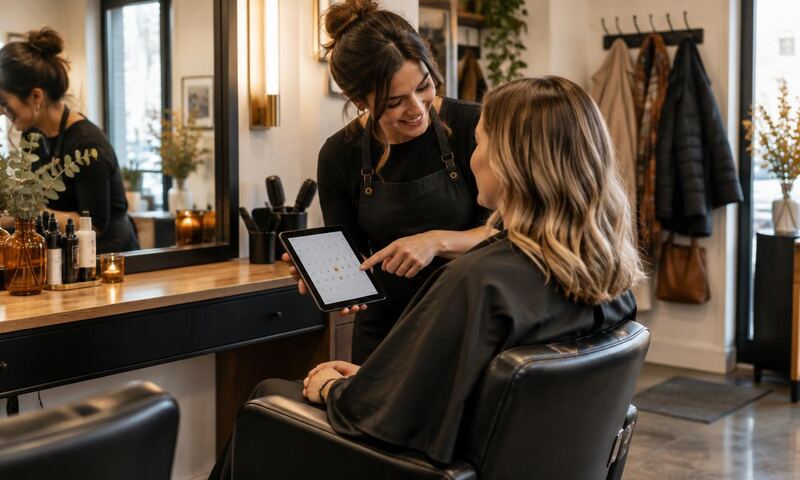
The visit just ended, she is reaching for her keys, and the next appointment has not been discussed. One version of this moment offers the next slot while the visit is fresh. The other leaves it for later. Measure acceptance on each against your own baseline rather than assuming which one performs.
Rebooking is not a marketing problem. It is a moment problem. The moment ends when she walks out. Everything below is the mechanics of catching that moment consistently, without relying on staff to remember, willpower to hold, or a follow-up text to do the work a question would have done in ten seconds.
Checkout
Own the checkout moment
- 0mService ends
- 0–3mBest rebook moment
- Same dayFollow-up if missed
- 1 week+Attention fades
- 0mService ends
- 0–3mBest rebook moment
- Same dayFollow-up if missed
- 1 week+Attention fades
The checkout window is a high-intent moment for the customer. She just experienced the service, she is happy enough not to have walked out early, and her card is already in your hand.
This is when you ask for the next appointment. Not by text tomorrow, when she is at work and the visit already feels like last week. Now, while her calendar app is one tap away and the memory is warm.
The ask
Ask one specific question
Vague questions get vague answers. 'Do you want to book your next one?' produces 'I will figure it out later,' and later is a place customers go to die.
Ask a specific question with a specific time. 'For this service the usual window is about six weeks. Do you want the same day and time then, or does another day work better?' The specificity does the work. You are no longer asking her to plan her life. You are asking her to accept or adjust a proposal.
The person asking should be the one at the checkout screen. Not a follow-up text. Not a poster on the wall. A human, at the register, holding the appointment calendar.
Timing
Know the service cycle
The specific question only works if you know the specific window. Every service has one, and it is usually narrower than you think.
- 01Frequent trim services: 3 to 5 weeks.
- 02Color, chemical, or maintenance services: 4 to 8 weeks.
- 03Recovery, therapy, or coaching series: the cadence defined by the treatment plan.
- 04Preventive maintenance visits: quarterly or seasonal.
- 05Annual services: same month next year.
Fallback
When they say later, have a real later
Some customers cannot commit at checkout, and that is fine. 'Later' just cannot mean nothing. Nothing is what happens by default.
Trigger a rebooking reminder timed to the service cycle, sent on the channel she booked with. One message, at the window, with a booking link that pre-fills the same service so she does not have to remember what she had.
If she does not respond, one nudge two weeks later. After that, stop. A third message reads as pursuit and turns a customer into a case study for the competition.
Automation
Hand the rebooking to your booking tool
Do not keep a spreadsheet of when to text people. That spreadsheet is where good intentions go to be forgotten, and every row you miss is one visit's worth of revenue.
Configure the booking tool to schedule the follow-up as part of the current appointment record. The customer name, the last service, the last date, and the target rebooking window all live there already. Point the reminder at that data so the message is built from the booking record and fires on schedule whether or not you remembered it existed.
Frequently asked questions
Find out how much rebooking your loop is leaving on the table.
The free scan grades your booking path and lists the fixes that pay for themselves fastest.
No card, no sales call required. Report emailed to you.